Haitz’s Law; Partnering with AquiSense Technologies
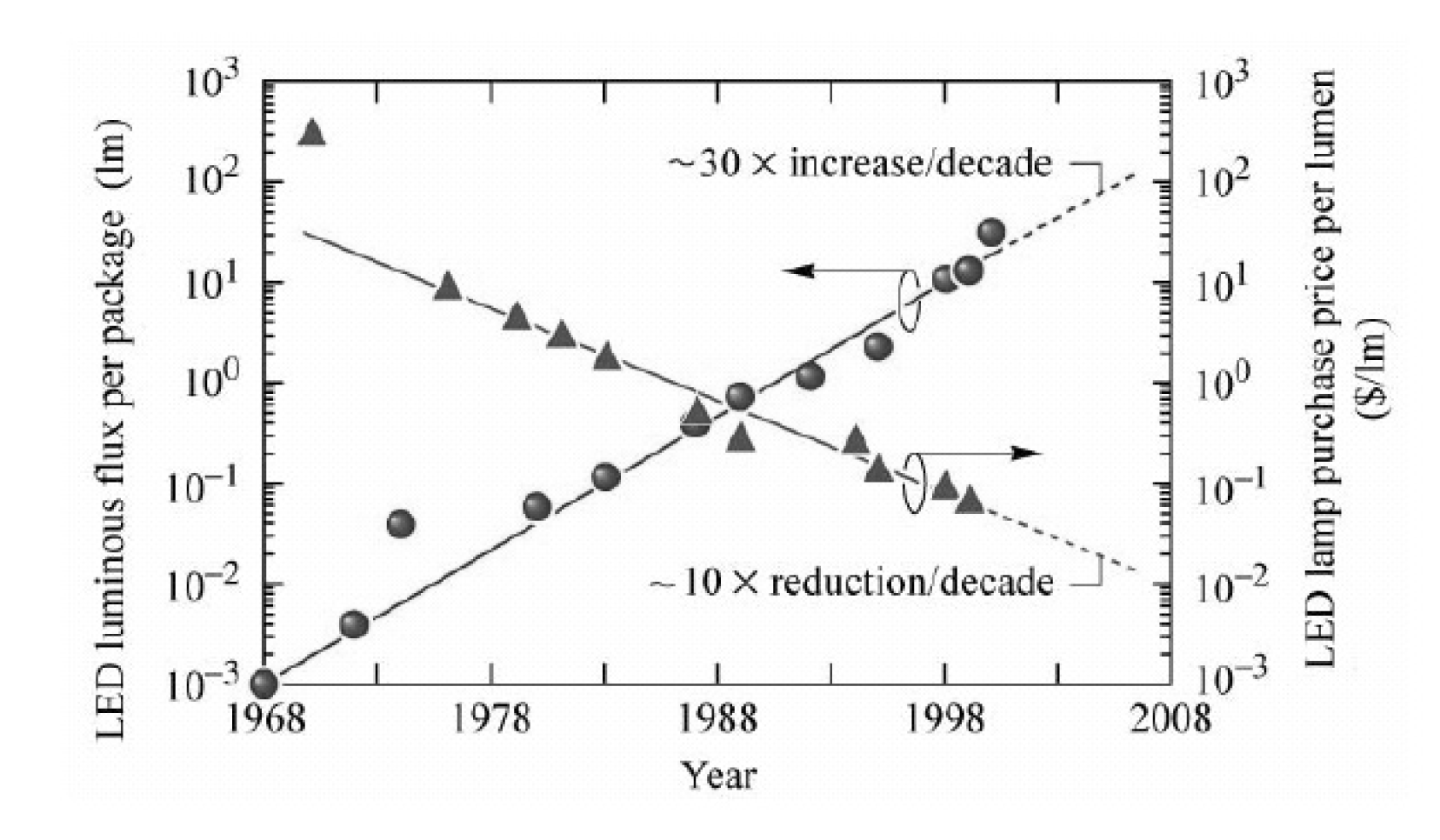
On February 10th, 2000, Strategies in Light hosted the first in a series of conferences focused on business opportunities in advanced LEDs. There, Roland Haitz, a scientist at Agilent Technologies, introduced what would become known as Haitz's Law.
The law states that every decade, the cost per lumen falls by a factor of ten, while light output per LED package increases by roughly a factor of twenty for a given wavelength.
Haitz presented the thesis primarily as a data-driven projection using trend charts, similar to how Gordon Moore originally illustrated Moore's Law. His charts traced three converging trends: light output per LED package growing exponentially, cost per lumen falling as manufacturing scaled, and luminous efficiency climbing toward major milestones - around 100 lm/W by 2010 and roughly 200 lm/W by 2020. The presentation extrapolated the historical LED performance curve forward, arguing that continued investment would sustain the trajectory. Haitz also emphasized the broader implication: LEDs reaching ~ 200 lm/W could reduce global electricity used for lighting by more than half. Both milestones were met: the 100 lm/W target arrived on schedule in 2010, and the 200 lm/W barrier was cleared ahead of time.
UV water disinfection is one of the oldest proven methods for eliminating pathogens without chemicals, dating back to 1877, when British scientists first demonstrated that ultraviolet light could kill bacteria. For most of the century that followed, mercury vapor lamps were the only practical way to deliver it at scale, enabled by quartz - the only material that could transmit UV-C while surviving the heat required to generate it.
It worked, but always as a compromise: fragile, slow to warm up, expensive to maintain, and dependent on mercury - a toxic element now being globally phased out under the UN’s Minamata Convention on Mercury, which adopted a full phase-out of dental amalgam by 2034 at its sixth conference in November 2025.
That changed in the early 2000s, when UV-C LEDs emerged as a viable alternative - fundamentally changing the equation. Unlike mercury vapor lamps, these solid-state devices contain no mercury, require no warm-up time, and eliminate fragile glass components. They deliver the same germicidal wavelengths in a compact, instant-on form by passing electrical current through advanced semiconductor materials.
AquiSense - dubbed the "EV for UV" - is built on that same logic: displacing mercury incumbents not just by being cleaner, but by being architecturally superior.
UV-C LEDs differ from conventional mercury lamps across nearly every major operating characteristic. Mercury lamps require 10 - 30 minutes of preheating and are often kept running continuously to avoid startup delays, whereas UV-C LEDs activate instantly. Their compact, solid-state design makes them far easier to integrate into portable and household devices, unlike their bulkier counterpart. UV-C LEDs also contain no mercury, eliminating the environmental and health risks associated with handling or breakage. More durable by design, they offer longer operational lifespans and far greater resistance to vibration and shock than fragile mercury lamp tubes.
AquiSense Sends UV-C System to the International Space Station
AquiSense's product line spans the full treatment spectrum. At the residential end, the PearlAqua Micro handles under-sink and countertop disinfection. Scaling up, the Kilo and Tera serve mid-size industrial systems through city-scale municipal treatment. The company also addresses adjacent markets - pharmaceutical process fluids, ultra-pure water, and surface and air disinfection in aerospace settings - giving it exposure across regulated, high-value verticals beyond core water infrastructure.
Haitz's Law is already playing out in the underlying hardware - commercial 265nm UV-C LEDs have recently quadrupled in power - jumping from below 50 milliwatts to 200 milliwatts.
As cost-per-lumen drops tenfold each decade, AquiSense's advantage over mercury incumbents grows more pronounced - legacy systems sit on a flat cost curve with no equivalent trajectory for improvement - a structural disadvantage that only compounds as mercury bans and tightening EPA standards accelerate the transition. That regulatory pressure is now hitting at the exact moment UV-C LED technology has crossed the threshold for municipal-scale deployment. Backed by industry-first EPA and NSF validations, AquiSense is precisely positioned to capture this shift - a claim already proven by revenue from Abbott, Coca-Cola, Lowe's, and NASA.